
Tap the button to copy 🤔
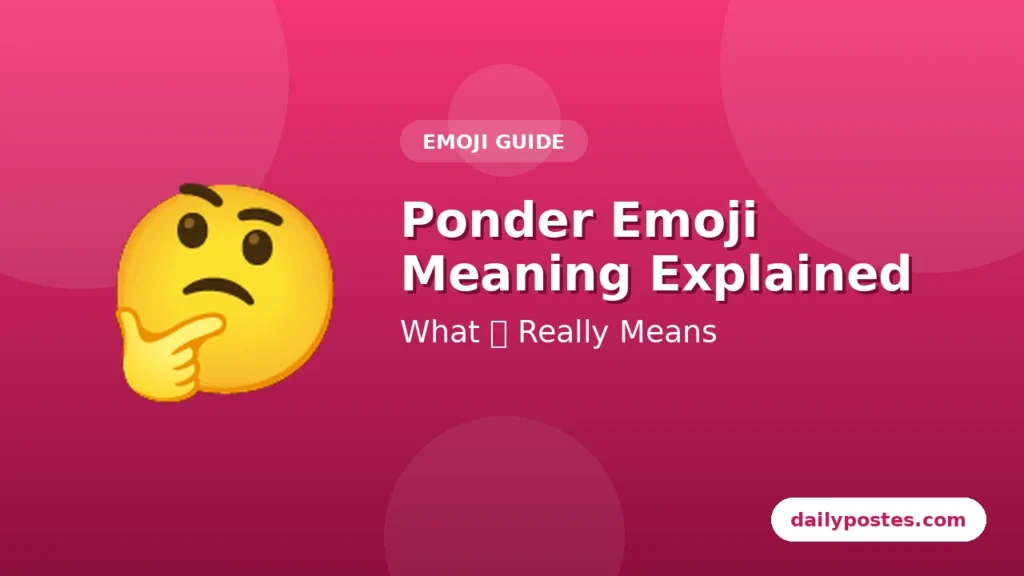
The 🤔 emoji is the thinking face. It means pondering, considering, or questioning something: deep thought, healthy doubt, or a playful “hmm, really?” Copy it from the box above.
Quick Facts
| Emoji | 🤔 |
| Unicode name | Thinking face |
| Codepoint | U+1F914 |
| Shortcode | :thinking_face: |
| Introduced | Unicode 8.0 (2015) |
In This Article
- What Does the 🤔 Emoji Mean?
- Why Is the Thinking Emoji So Iconic?
- What Does 🤔 Mean in Texting?
- When Should You Use the 🤔 Emoji?
- What Does 🤔 Mean From a Girl?
- What Does 🤔 Mean From a Guy?
- 🤔 vs 🧐 vs 🤨: What’s the Difference?
- Does 🤔 Look Different on iPhone and Android?
- Fun 🤔 Emoji Combinations
- People Also Ask
What Does the 🤔 Emoji Mean?
The 🤔 emoji is officially called “thinking face.” It shows a yellow face with a hand pressed against its chin, one eyebrow raised, and eyes glancing upward and to the side. The universal body language of turning an idea over in your mind.
At its core, 🤔 means pondering. Thinking deeply, weighing options, considering something carefully. When someone sends it, their brain is working on it. The texting equivalent of stroking your chin and staring at the ceiling.
But 🤔 has a second famous meaning: doubt. That raised eyebrow does a lot of work. “Hmm, really?” “Are you sure about that?” After a bold claim, it quietly questions it without starting a fight. Skepticism wearing a polite smile.
This double life is what makes 🤔 special. Sincere (“let me think about that”) or sarcastic (“sure, Jan”). Context decides which one you are getting.
It also works as a tone-setter. A plain statement like “interesting idea” reads flat on its own. Add 🤔 and it gains a whole mood: curious, cautious, maybe a little mischievous. That is why people reach for it when words alone feel too blunt or too boring.
Why Is the Thinking Emoji So Iconic?
🤔 is one of the most versatile emojis ever made. Here is why it became a classic:
- The gesture is universal. Every culture reads the hand-on-chin pose as “I am thinking.” No language needed. A philosopher in ancient Greece and a teenager today would understand it the same way.
- It does two opposite jobs. Genuine thought and playful doubt live in the same face. Few emojis pull off sincerity and sarcasm at once, which makes 🤔 useful in almost any conversation.
- It softens disagreement. Saying “I doubt that” in words can sound confrontational. Sending 🤔 after a claim says the same thing with a wink. It lets people question each other without damaging the vibe.
- Meme culture made it immortal. The thinking pose became the reaction image for fake-deep thoughts, shower thoughts, and conspiracy jokes. Once an emoji becomes a meme template, it stays relevant forever.
What Does 🤔 Mean in Texting?
In texting, 🤔 plays several distinct roles:
1. Genuinely thinking it over. “Hmm, let me think about the weekend plans 🤔.” The emoji is literal here. They need a moment, and it buys them time gracefully.
2. Healthy skepticism. “He said he finished in an hour 🤔.” Translation: “I do not fully buy that.” It questions the claim without accusing anyone of lying.
3. The sarcastic “really?” “Oh, you are ‘too busy’ to reply for three days 🤔.” Everyone knows what this means. Doubt with an edge, usually aimed at a weak excuse.
4. Stalling politely. “🤔 let me get back to you on that.” Instead of leaving you on read, they signal the topic is parked, not ignored.
5. Fake deep thought (as a joke). “What if we are all just Sims 🤔.” The emoji sells the bit. It makes a silly shower thought feel like philosophy.
6. Weighing options out loud. “Pizza 🤔 or tacos 🤔.” It turns an internal debate into a shared one and invites the other person to vote.
🤔 always marks a pause for thought, whether that thought is serious, doubtful, or completely unserious.
When Should You Use the 🤔 Emoji?
Use it when:
- You are genuinely considering something and want them to know you are thinking, not ignoring them.
- You doubt a claim but want to question it lightly instead of arguing.
- You are joking about overthinking something silly.
- You want to invite someone into a decision (“beach 🤔 or mountains 🤔”).
- Reacting to a plot twist, a surprising fact, or a mystery worth pondering.
Do NOT use it when:
- Someone is sharing something vulnerable. 🤔 after bad news reads as cold and dismissive. They need empathy, not analysis.
- You actually disagree strongly. Hiding a real objection behind 🤔 breeds confusion. Say what you mean instead.
- In professional chats about decisions. A lone “🤔” looks indecisive at work. Add words explaining what you need.
- The sarcastic version with someone who will not get the joke. Doubt-as-humor only works when the relationship can take it.
Simple rule: use 🤔 to show your mind is open, never to pretend it is made up.
What Does 🤔 Mean From a Girl?
When a girl sends 🤔, she is processing something. The flavor depends on what you just said.
She is thinking it over. You suggested plans, she replied “🤔 maybe.” She has not decided yet. Give her space instead of pushing for an instant answer.
She is skeptical of your story. “You were ‘at home all night’ 🤔.” That raised eyebrow is doing heavy lifting. She is not buying it, and she wants you to know.
She is weighing you. After a bold text, 🤔 can mean “I am deciding how I feel about this.” Neither yes nor no. The space between.
She is playfully suspicious. “You remembered my birthday 🤔 impressive.” The doubt is affectionate here. Teasing, not accusing.
She is stalling with style. Instead of “idk,” she sends 🤔. Same meaning, smarter delivery, and the conversation stays warm.
Bottom line: 🤔 from a girl almost always means she is still deciding. About the plan, the story, or you. Patience reads better than pressure.
What Does 🤔 Mean From a Guy?
From a guy, 🤔 is usually straightforward, but not always innocent:
- He is actually thinking. “🤔 let me check my schedule.” Often literal, a placeholder while his brain catches up. No hidden meaning most of the time.
- He doubts you. “She said the traffic was bad 🤔.” Same raised-eyebrow energy. Questioning the excuse without making it a confrontation.
- He is trolling lightly. Dropping 🤔 under a friend’s confident statement is classic banter. “I am definitely right 🤔” means “we will see about that.”
- He is dodging a direct answer. Ask a tricky question and 🤔 buys him time. The emoji version of “that’s a good question,” which sometimes means “I have no answer.”
- He is fake-pondering for comedy. “Is a hot dog a sandwich 🤔.” Peak humor: treating a dumb question like a philosophical crisis.
🤔 vs 🧐 vs 🤨: What’s the Difference?
These three get mixed up constantly. Here is how to tell them apart:
| Emoji | Name | Vibe |
| 🤔 | Thinking face | Pondering or doubting: “hmm, let me think” or “really?” |
| 🧐 | Face with monocle | Close inspection: examining details, being fancy or nerdy about it |
| 🤨 | Face with raised eyebrow | Pure suspicion: “I don’t believe you,” no thinking involved |
Quick rule: 🤔 questions with curiosity, 🤨 questions with attitude, and 🧐 inspects the details.
Does 🤔 Look Different on iPhone and Android?
A little, but the chin-stroke always reads clearly.
On iPhone, it is a yellow face with a hand cupping the chin, thumb and fingers visible, one eyebrow arched high, and eyes looking up and sideways. The thinking pose is unmistakable.
On Android and other platforms, the same elements appear: hand on chin, raised eyebrow, sidelong glance. Art styles differ slightly, but the “deep in thought” message survives everywhere.
The raised eyebrow is the load-bearing feature. As long as it is arched, 🤔 works on any phone ever made.
Fun 🤔 Emoji Combinations
Pair 🤔 with other emojis to sharpen the thought:
| Combo | What it suggests |
| 🤔💭 | Deep in thought: the classic pondering pair |
| 🤔❓ | Genuinely questioning: “I really don’t know” |
| 🤔👀 | Suspicious thinking: “I’m watching and wondering” |
| 🤔💡 | Thought turning into an idea: the lightbulb moment |
| 🤔🤷 | Thoughtful shrug: “I’ve considered it, still no clue” |
| 🍕🤔🍔 | The eternal food debate |
| 🤔📝 | Thinking before replying: taking it seriously |
| 🤔😏 | Skeptical but amused: “sure, buddy” |
More Thinking Emojis to Copy and Paste
Tap any emoji to copy it instantly, then paste it anywhere you like.
Tap any emoji to copy it. Paste it anywhere: WhatsApp, Instagram, TikTok, or your messages.
People Also Ask
What is the 🤔 emoji officially called?
Its official Unicode name is “thinking face” (codepoint U+1F914). It was added in Unicode 8.0 in 2015.
Does 🤔 mean confused?
Not exactly. Confusion is “I don’t understand.” 🤔 is “I’m working on understanding.” It is active thinking, not lost thinking.
Is 🤔 sarcastic?
It can be. “Oh really 🤔” is the sarcastic use. But it is just as often sincere. The surrounding text tells you which.
What does 🤔 mean when a girl sends it after your excuse?
She doubts the excuse. The raised eyebrow is a polite way of saying “I don’t believe you” without starting a fight.
Why do people use 🤔 for conspiracy theories?
Because the chin-stroking pose is the visual shorthand for “question everything.” It makes any wild theory feel like deep investigation.
What is the difference between 🤔 and 🤨?
🤔 includes thinking or pondering. 🤨 is pure suspicion with no thought involved: just disbelief.
How do I type the thinking emoji?
Open your emoji keyboard and search “think.” In Slack or Discord, type the shortcode :thinking_face:.
Can 🤔 be flirty?
Yes, in the right context. “Dinner Friday? 🤔” after you suggest plans can mean playful stalling, like they are pretending to need convincing. The tone depends entirely on your dynamic.
What does 🤔💭 mean together?
Deep thought in progress. The thought-balloon 💭 doubles down on the pondering, so the combo reads as “seriously considering this right now” rather than casual doubt.
Conclusion
The 🤔 emoji is proof that thinking has a face. Genuine pondering, polite doubt, or a joke about overthinking tacos: that hand on the chin says what words often cannot. My mind is working on it.
Use it to show thought instead of silence. Question claims with a wink instead of a war. And next time you need a moment to contemplate life’s big questions, like pizza or tacos, let 🤔 hold the pose for you.
Want more? Explore Smileys & Emotion and Faces & Expressions for more emoji guides, or learn about DailyPostes.