
Tap the button to copy 🫤
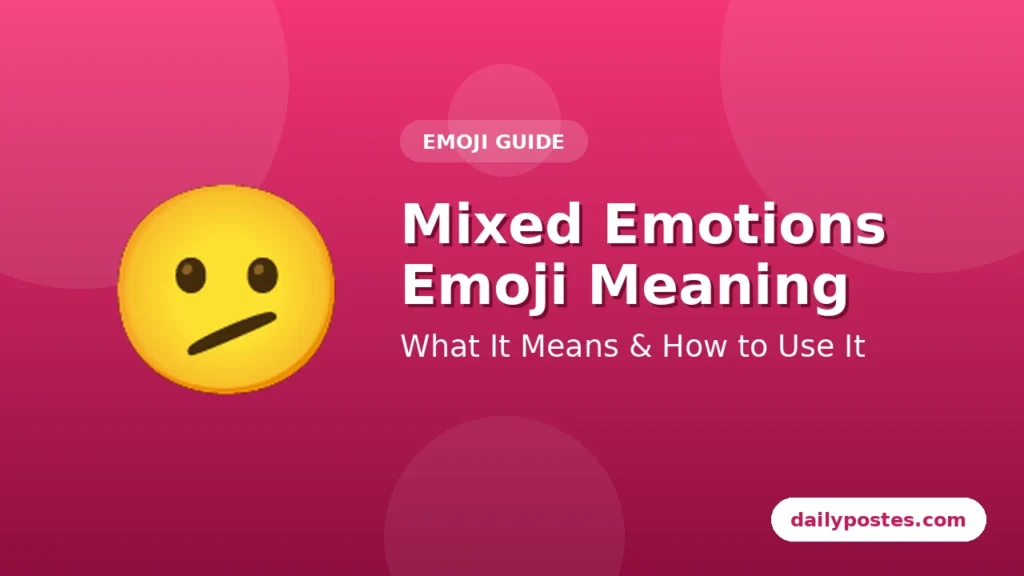
The 🫤 emoji is the face with the diagonal mouth. It means mixed feelings, uncertainty, or quiet skepticism. Use it when you are not sure what to think, when something feels off, or when you want to disagree without starting a fight. Copy it from the box above.
Quick Facts
| Emoji | 🫤 |
| Unicode name | Face with diagonal mouth |
| Codepoint | U+1FAE4 |
| Shortcode | :diagonal_mouth: |
| Introduced | Unicode 15.0 (2022) |
In This Article
- What Does the 🫤 Emoji Mean?
- Why Did the Mixed Emotions Emoji Become So Popular?
- What Does 🫤 Mean in Texting?
- When Should You Use the 🫤 Emoji?
- What Does 🫤 Mean From a Girl?
- What Does 🫤 Mean From a Guy?
- What Does 🫤 Mean on TikTok and Instagram?
- 🫤 vs 🙃 vs 😕: What’s the Difference?
- Does 🫤 Look Different on iPhone and Android?
- Fun 🫤 Emoji Combinations
- FAQs
What Does the 🫤 Emoji Mean?
The 🫤 emoji is officially called “face with diagonal mouth.” It shows a yellow face with a mouth slanted at a strange angle, like someone who cannot decide whether to smile or frown. The eyes look a little flat and unimpressed. That single crooked mouth does all the talking.
At its core, 🫤 means “I am not sure how I feel about this.” It is the emoji of mixed emotions, quiet doubt, and polite uncertainty. It sits in the space between agreement and disagreement, between amusement and annoyance. When plain words feel too strong and saying nothing feels too weak, 🫤 lands in the middle.
People also use it for mild skepticism (“really?”), awkwardness (“well, this is uncomfortable”), and self-aware embarrassment (“yeah, that was my fault”). It can carry a hint of sarcasm too, but usually the soft kind, not the mean kind.
Think of it as the emoji version of a raised eyebrow plus a sideways glance. Nobody is crying. Nobody is laughing. Someone is just… processing. That is what makes 🫤 so relatable. Real life is full of moments where you genuinely do not know what to say, and now there is a face for that.
One more thing worth knowing: 🫤 is a newer emoji, added in Unicode 15.0 in 2022. It filled a gap that people had complained about for years. Before it existed, there was no clean way to say “I have mixed feelings” in one tap. Texters either overused 🙃 or just wrote out long explanations. Now the diagonal mouth handles it in a single character.
Why Did the Mixed Emotions Emoji Become So Popular?
🫤 exploded because it names a feeling everyone has but almost no emoji captured.
First, it is the most honest emoji on the keyboard. Most emojis pick a side. They are happy, sad, angry, or in love. 🫤 refuses to pick one. That honesty matches how people actually feel most of the time, especially about news, plans, gossip, and group chat drama.
Second, it is the king of the soft disagreement. Telling someone “I think that is a bad idea” starts a fight. Replying with 🫤 says “I have doubts” without raising your voice. It is disagreement with a seatbelt on. In work chats and family groups where you cannot be blunt, this matters a lot.
Third, it thrives on awkwardness. Modern internet humor runs on awkward moments: bad takes, weird videos, uncomfortable truths. 🫤 is the perfect reaction. It says “yikes, but politely.” Comment sections are full of it.
Fourth, it works as self-roast. People love using 🫤 on themselves: “Me: I will save money this month. Also me at the mall 🫤.” It turns mild self-criticism into a joke instead of a complaint. That is a very shareable energy.
Fifth, it is meme-proof. Because 🫤 never commits to one emotion, it never feels outdated or overused in the wrong context. It is flexible by design, so it keeps fitting new situations. New emojis often fade after the novelty wears off. This one stuck around because it solved a real problem.
What Does 🫤 Mean in Texting?
In texting, 🫤 usually plays one of these roles:
1. Uncertainty. “I guess I could come on Friday 🫤.” The person has not decided. The emoji is doing the shrugging so their words do not have to.
2. Quiet skepticism. “He said he will definitely be on time 🫤.” Translation: I doubt it, but I am not going to argue. This is the number one use among friends.
3. Awkward acknowledgment. When someone tells you something uncomfortable and you do not know what to say, 🫤 buys you time. It says “noted” with a complicated face.
4. Polite disagreement. “Interesting idea 🫤.” Read between the lines: they are not sold on it. This is the softest possible way to pump the brakes.
5. Self-aware embarrassment. “I just realized I have been pronouncing it wrong for three years 🫤.” Owning the mistake with a crooked smile takes the sting out.
6. Playful sarcasm. “Oh great, another meeting 🫤.” Everyone knows meetings are not great. The emoji makes the complaint funny instead of bitter.
The key detail: 🫤 is almost never angry. It is the opposite of 😡. If someone wanted to fight you, they would pick a different face. The diagonal mouth signals hesitation, not hostility. Keep that in mind when you receive one. It is usually not an attack.
When Should You Use the 🫤 Emoji?
Use it when:
- You genuinely have mixed feelings and want to be honest about it.
- You doubt something but do not want to start an argument.
- The situation is awkward and you need a light, non-dramatic reaction.
- You are poking fun at yourself for a small mistake.
- You want to say “I am not convinced” in a friendly way.
Do NOT use it when:
- Someone shares genuinely sad or serious news. A crooked mouth can look cold next to real pain. Use kind words instead.
- You need to give a clear yes or no. 🫤 will only confuse things. Say the actual answer.
- You are dealing with your boss or a client and the stakes are high. Uncertainty can read as unprofessional.
- You actually agree with someone. Do not drop a 🫤 on good news “just because.” It will be read as doubt.
- The conversation needs warmth. 🫤 is dry by nature. Add a warmer emoji if you care about the person.
Simple rule: 🫤 is for gray areas. If the situation is black or white, pick an emoji that matches.
What Does 🫤 Mean From a Girl?
When a girl sends 🫤, context is everything. This emoji is deliberately vague, so read the sentence it came with.
She is not convinced. “Sure, let’s try your plan 🫤.” She is going along with it, but she has doubts. If you want her real opinion, ask directly. The emoji is an invitation to dig deeper.
She is being playfully skeptical. “You? Early? 🫤.” This is teasing, not fighting. She knows your habits and she is calling you out with a smile. Tease back.
She feels awkward. If the topic got uncomfortable, 🫤 is her way of signaling “this is weird” without making it a whole thing. Changing the subject is usually the right move.
She is giving you a soft no. “Maybe another time 🫤.” Girls sometimes use 🫤 to decline gently instead of saying a hard no. Do not push. A soft no is still a no.
She is roasting herself. “I just waved back at someone who was not waving at me 🫤.” Laugh with her. Shared embarrassment is bonding.
The pattern: from a girl, 🫤 is usually diplomatic. It softens whatever she is saying. If she wanted to be harsh, she would pick a sharper emoji. Treat a 🫤 as “I am telling you gently” and respond with the same energy.
What Does 🫤 Mean From a Guy?
From a guy, 🫤 tends to be more deadpan and dry.
He is doing a “we will see.” “Yeah, sounds fun 🫤.” He is not excited. He is not angry. He is just… not sold. Among guys, this is the standard setting for anything they did not suggest themselves.
He is bantering. “Nice haircut 🫤.” Depending on your friendship, this is either a roast or a backhanded compliment. Guys use 🫤 as punctuation for dry humor. If he follows it with 😂, it was a joke.
He is admitting a small L. “Forgot my wallet again 🫤.” No excuses, no drama, just a crooked mouth and quiet shame. Respect the honesty.
He is dodging the question. “So are you coming or not? 🫤.” This is the emoji equivalent of looking at the ceiling. He does not want to answer yet. Give him a minute or ask again later.
He genuinely does not know. Sometimes a 🫤 is not hiding anything. Some guys are just not sure what they think, and the emoji says so plainly. Not every message has a hidden layer.
What Does 🫤 Mean on TikTok and Instagram?
On social media, 🫤 has become the default reaction to content that makes people go “hmm.”
On TikTok, 🫤 lives in the comments of videos that are hard to categorize: a life hack that might be fake, a hot take that is half right, a storytime with a twist nobody asked for. It is the comment-section way of saying “I do not know what to think about this, but I watched the whole thing.” It also shows up under “POV” videos where the situation is deliberately awkward.
On Instagram, 🫤 appears under relatable memes about indecision, dating confusion, and adulting fails. “Me deciding whether to text back 🫤” is a whole genre. It is also common in stories polls, where people post a question they cannot answer themselves and let the emoji do the talking.
The pattern across both platforms: 🫤 marks content about uncertainty. If a post made thousands of people unsure what to feel, the comments fill up with diagonal mouths. It is basically the internet’s collective shrug.
🫤 vs 🙃 vs 😕: What’s the Difference?
These three get mixed up because they all live in “not quite sure” territory. Here is how they differ:
| Emoji | Name | Vibe |
| 🫤 | Face with diagonal mouth | Mixed feelings — skeptical, uncertain, awkward, dry |
| 🙃 | Upside-down face | Playful sarcasm — “this is fine” energy, joking through pain |
| 😕 | Confused face | Genuinely puzzled — “I don’t understand,” sadder and softer |
Use 😕 when you are truly confused and maybe a little sad about it. Use 🙃 when you are being ironic or making light of a bad situation. Use 🫤 when you are undecided or unimpressed rather than confused. The diagonal mouth is about judgment, not bewilderment.
A quick test: if the sentence could end with “we will see,” 🫤 is right. If it could end with “haha, kill me,” 🙃 fits better. If it could end with “can someone explain?” pick 😕.
Does 🫤 Look Different on iPhone and Android?
A little, and for this emoji the details matter more than usual.
On iPhone, 🫤 has a clearly slanted mouth that runs from lower-left to upper-right, with slightly uneven eyes that sell the “not impressed” look. The whole face tilts into the expression. It reads instantly as mixed feelings.
On Android (Google’s style) and most other platforms, the design is similar: same crooked mouth, same flat eyes. The exact angle of the mouth varies a bit, and the shade of yellow differs, but the message survives. Samsung and other vendors keep the same core idea.
One caution: because 🫤 is a newer emoji (2022), very old phones and outdated apps may show it as a blank box or a question mark. If you are texting someone on an ancient device, they might not see the face at all. On anything made in the last few years, you are fine.
Fun 🫤 Emoji Combinations
Pair 🫤 with other emojis to fine-tune the message:
| Combo | What it suggests |
| 🫤🤷 | Total uncertainty — “I honestly don’t know” |
| 🫤😂 | Awkward laughter — “this is funny but also weird” |
| 🫤👀 | Suspicious side-eye — “I’m watching this unfold” |
| 🫤💭 | Still thinking — “let me get back to you” |
| 🫤😅 | Nervous self-awareness — “yeah, that was me” |
| 🫤👍 | Reluctant agreement — “fine, I guess” |
| 🫤🤔 | Deep doubt — “something doesn’t add up” |
| 🫤🙃 | Double dryness — maximum sarcasm, handle with care |
More Confused Emojis to Copy and Paste
Tap any emoji to copy it instantly, then paste it anywhere you like.
Tap any emoji to copy it. Paste it anywhere: WhatsApp, Instagram, TikTok, or your messages.
Frequently Asked Questions
What is the 🫤 emoji officially called?
Its official Unicode name is “face with diagonal mouth” (codepoint U+1FAE4). It was added in Unicode 15.0 in 2022.
Does 🫤 always mean mixed emotions?
That is its main meaning, but it also covers skepticism, awkwardness, mild disapproval, and dry sarcasm. Context decides which one.
What is the difference between 🫤 and 😕?
🫤 is undecided or unimpressed (a judgment). 😕 is genuinely confused and a bit sad (a question). They look similar but feel different.
Can I use 🫤 sarcastically?
Yes, but keep it gentle. 🫤 sarcasm is dry, not cruel. Pair it with 😂 if you want to make the joke obvious.
What does it mean when a girl sends 🫤?
Usually polite skepticism or a soft disagreement. She is telling you something gently. Read the sentence around it for the full picture.
Why do I see a box instead of 🫤?
Your device or app is too old to support Unicode 15.0 emojis. Update your phone’s software and it should appear.
How do I type the mixed emotions emoji?
Open your emoji keyboard and search “diagonal” or “mixed.” In Slack or Discord, type the shortcode :diagonal_mouth:.
Final Thoughts
The 🫤 emoji is proof that you do not always need an answer. Some moments are confusing, some plans are questionable, and some news just leaves you ambivalent. That is not a weakness. It is honesty.
Use 🫤 when the feeling is complicated. Keep it kind. And remember that a crooked little mouth can say what a paragraph cannot: “I am still making up my mind.”
Want more? Explore Smileys & Emotion and Faces & Expressions for more emoji guides, or learn about DailyPostes.