
Tap the button to copy 🙂
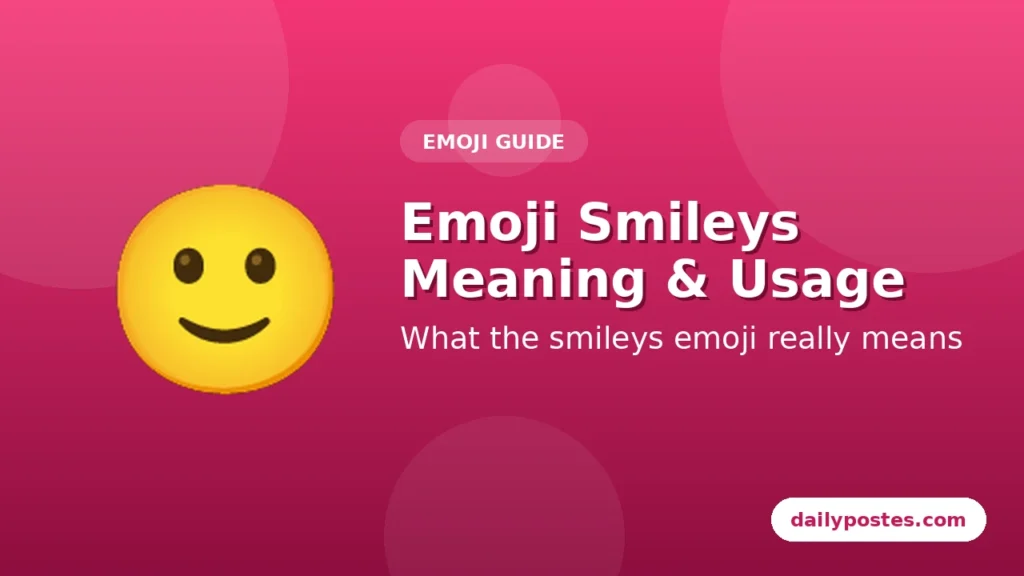
The 🙂 emoji is officially the “slightly smiling face.” It is the polite, neutral smiley: a small, even smile with ordinary eyes. It means “I’m fine,” “sounds good,” or a friendly nod. It is warmth on its lowest setting, and that is exactly why people love it. Copy it from the box above.
Quick Facts
| Emoji | 🙂 |
| Unicode name | Slightly smiling face |
| Codepoint | U+1F642 |
| Shortcode | :slightly_smiling_face: |
| Introduced | Unicode 7.0 (2014) |
In This Article
- What Does the 🙂 Emoji Mean?
- Why Are Emoji Smileys So Popular?
- What Does 🙂 Mean in Texting?
- When Should You Use the 🙂 Emoji?
- What Does 🙂 Mean From a Girl?
- What Does 🙂 Mean From a Guy?
- What Does 🙂 Mean on TikTok and Instagram?
- 🙂 vs 😊 vs 😌: What’s the Difference?
- Does 🙂 Look Different on iPhone and Android?
- Fun 🙂 Emoji Combinations
- FAQs
What Does the 🙂 Emoji Mean?
The 🙂 emoji is officially called “slightly smiling face.” It shows a plain yellow face with regular eyes and a small, closed-lip half smile. No grin, no blush, no excitement. Just a calm, even expression that says: everything is fine here.
Of all the smileys in the emoji keyboard, 🙂 is the most neutral one. 😄 is happy. 😊 is warm. 🙂 is simply pleasant. It is the digital equivalent of the polite smile you give a stranger in an elevator, or the friendly nod when a coworker walks past your desk. Nothing more, nothing less.
That neutrality is exactly what made 🙂 famous, and also what made it complicated. In some conversations it means genuine friendliness. In others, people read it as a thin, holding-back-something smile: “I’m being polite but I don’t want to talk about this.” The words around it decide which one you are looking at.
Think of 🙂 as the lowest honest setting of happiness. It cannot promise joy, warmth, or excitement. What it can promise is: I read your message, I am okay, and I mean you no harm.
Why Are Emoji Smileys So Popular?
A few reasons explain why the plain 🙂 became one of the most-used faces on earth.
First, it is the universal safe choice. Every other smiley commits to a feeling. 😂 says something is hilarious. 😊 says you are warm. 🙂 commits to nothing, which means it cannot be wrong. When in doubt, people reach for 🙂.
Second, it softens everything. “Okay.” reads as cold. “Okay 🙂” reads as friendly. The slight smile takes the edge off short messages and makes texts feel human. In a world of one-line replies, 🙂 does the work of a friendly tone of voice.
Third, it is generation-proof. Teenagers use it sarcastically sometimes, and grandparents use it as plain friendliness. That tension made it a meme (“the passive-aggressive smiley”), but underneath, both generations keep using it because it simply works.
Fourth, it fits work and life. 🙂 is the only smiley that feels natural in a work Slack channel and equally natural in a text to your mom. No other emoji crosses that boundary so cleanly.
What Does 🙂 Mean in Texting?
In texting, 🙂 has several common jobs:
1. Friendly acknowledgment. “Got it 🙂.” Translation: I read your message and all is well. This is the number one use.
2. Polite agreement. “Sounds good 🙂.” A little warmer than a bare “sounds good.” It says the agreement is genuine, or at least not hostile.
3. Gentle deflection. “Haha yeah 🙂.” Here the smiley closes the topic without being rude. It is the polite way to say “I don’t want to get into this.”
4. Masked feelings (the meme version). “I’m fine 🙂.” Everyone has seen this one. The slight smile that hides exhaustion, annoyance, or a whole bad day. People joke about it, but the joke exists because it is real.
5. Soft positivity. “Morning 🙂.” A mild, pleasant greeting. Not excited, not grumpy. Just a decent morning face.
6. Low-key flirting. Rare, but real. 🙂 keeps things deniable. It says “I’m being sweet” while leaving total room to claim “I’m just being friendly.”
The rule of thumb: 🙂 means the feeling is mild and managed. Big emotions get bigger emojis. 🙂 is for everything that is simply okay.
When Should You Use the 🙂 Emoji?
Use it when:
- You want to acknowledge a message warmly without making a big deal of it.
- You are agreeing politely and want it to read as genuine.
- You need to soften a short or plain message.
- You are in a work or formal chat and need one safe emoji.
- You genuinely feel calm, content, and fine.
Do NOT use it when:
- You are actually upset and the 🙂 will read as icy. If you are annoyed, say so with words instead of hiding behind a smiley.
- The moment deserves real enthusiasm. “We got married 🙂” wastes the occasion. Big news needs 😍 or 🎉, not a slight smile.
- Someone needs comfort. A grieving friend does not need 🙂; they need actual words.
- You are ending an argument. 🙂 after a fight reads as dismissive, not peaceful.
Simple rule: use 🙂 for mild, honest feelings. If the feeling is bigger than “slightly,” pick a bigger emoji.
What Does 🙂 Mean From a Girl?
When a girl sends 🙂, read it carefully. This is one emoji where context does almost all the work.
She is being politely friendly. The most common read. “See you there 🙂” usually means exactly that: a pleasant, normal goodbye.
She is keeping distance. One-word answer plus 🙂 (“ok 🙂”) often means the conversation is over for now. She is not angry, but she is not engaging either. Give her space.
She is hiding her real mood. “I’m fine 🙂” is the classic. If the conversation before it was tense, the 🙂 is a lid on a pot. Do not poke at it; ask gently how she really is.
She is being playfully mild. With a crush or a friend she likes, 🙂 can be sweet in a low-key way. “You remembered 🙂.” That little smile says your effort landed.
The key: 🙂 from a girl is rarely random. If the words are short and the smile is slight, the message between the lines matters more than the emoji.
What Does 🙂 Mean From a Guy?
From a guy, 🙂 is usually simpler than from a girl. Most of the time it is exactly what it looks like.
He is acknowledging you. “Cool 🙂.” Guys use 🙂 as a receipt: message received, all good. Do not read deeper than that.
He is softening bluntness. Guys know their short replies can sound cold. “Yeah 🙂” is him adding a smile so you do not think he is mad. It is considerate, in a guy way.
He is done with the topic. “Alright 🙂” often means: understood, moving on. It is not rude. It is just how many guys signal a clean end.
He is being genuinely pleasant. Some guys use 🙂 as their default friendly face. If he uses it everywhere, it means nothing more than “I’m easygoing.”
What Does 🙂 Mean on TikTok and Instagram?
On social media, 🙂 has two lives: the sincere one and the meme one.
On TikTok, 🙂 shows up in comments as both a wholesome reaction and the famous “holding it together” meme. “My boss just scheduled a 7am meeting 🙂.” Everyone understands that version instantly: the smile is doing its best while the person behind it is not okay.
On Instagram, 🙂 appears in DMs and comments as a friendly, low-stakes reaction. Story replies like “nice 🙂” are the digital version of a thumbs up with better manners. Creators use it to stay warm without over-promising excitement.
The pattern: on social media, 🙂 marks moments that are fine, or fine-adjacent. Sometimes genuinely pleasant. Sometimes barely surviving. The comedy comes from the gap.
🙂 vs 😊 vs 😌: What’s the Difference?
These three calm faces get mixed up all the time. Here is the breakdown:
| Emoji | Name | Vibe |
| 🙂 | Slightly smiling face | Neutral and polite — friendly on the surface, feelings unknown |
| 😊 | Smiling face with smiling eyes | Warm and genuine — shy happiness, real affection |
| 😌 | Relieved face | Calm and settled — the sigh-after-stress face |
Use 😊 when you feel real warmth. Use 😌 when a worry just lifted. Use 🙂 when you simply want to seem pleasant, no deeper claim involved.
Does 🙂 Look Different on iPhone and Android?
Slightly, but the politeness survives on every platform.
On iPhone, 🙂 is a yellow face with simple dot eyes and a small, even half-smile. The expression is famously flat, which is exactly why the meme culture adopted it: the face gives away nothing.
On Android and other platforms, the design is nearly identical: same plain eyes, same slight smile. Some versions tilt the smile a touch higher, which can make it read a little warmer or a little more sarcastic depending on your mood.
Because the face is so simple, 🙂 is one of the most consistent emojis across platforms. What you see is what they sent, and what they sent is a polite little smile.
Fun 🙂 Emoji Combinations
Pair 🙂 with other emojis to fine-tune the feeling:
| Combo | What it suggests |
| 🙂👍 | Friendly agreement — “sounds good” |
| 🙂🙏 | Polite thanks — gracious and calm |
| 🙂☕ | Chill morning energy |
| 🙂💀 | “I’m fine” (I’m not fine) — the meme version |
| 🙂✌️ | Casual, easygoing sign-off |
| 🙂🌤️ | Pleasant day, nothing dramatic |
| 🙂📝 | “Noted” — polite acknowledgment at work |
| 🙃🙂 | Mild confusion kept polite |
More Smiley Emojis to Copy and Paste
Tap any emoji to copy it instantly, then paste it anywhere you like.
Tap any emoji to copy it. Paste it anywhere: WhatsApp, Instagram, TikTok, or your messages.
Frequently Asked Questions
What is the 🙂 emoji officially called?
Its official Unicode name is “slightly smiling face” (codepoint U+1F642). It was added in Unicode 7.0 back in 2014.
Does 🙂 mean passive-aggressive?
It can, but usually it does not. The passive-aggressive read comes from meme culture. Most of the time 🙂 is just polite friendliness. Check the words around it before assuming attitude.
What is the difference between 🙂 and 😊?
😊 is warm, shy, and genuinely happy (the blush gives it away). 🙂 is neutral and polite — friendly on the surface with no strong feeling underneath.
Why do people call 🙂 the “I’m fine” emoji?
Because “I’m fine 🙂” became a meme for hiding bad moods behind a polite smile. The emoji became shorthand for feelings that are not being said out loud.
Is 🙂 okay to use at work?
Yes. It is one of the most professional-friendly emojis. It softens short messages without looking unprofessional.
What does 🙂💀 mean together?
The meme version: pretending to be fine while actually struggling. “Dead inside but staying polite.”
How do I type the slight smile emoji?
Open your emoji keyboard and search “slight smile.” In Slack or Discord, type the shortcode :slightly_smiling_face:.
Conclusion
The 🙂 emoji proves that a smile does not need to be big to matter. It is the emoji of everyday politeness: the friendly acknowledgment, the soft agreement, the calm “I’m fine.” It will never be the most exciting face in your keyboard, but it might be the most useful.
Use it when the feeling is mild and the manners matter. And when a short reply needs a human touch, let 🙂 do the smiling for you.
Want more? Explore Smileys & Emotion and Faces & Expressions for more emoji guides, or learn about DailyPostes.