
Tap the button to copy the cute happy emoji 😊
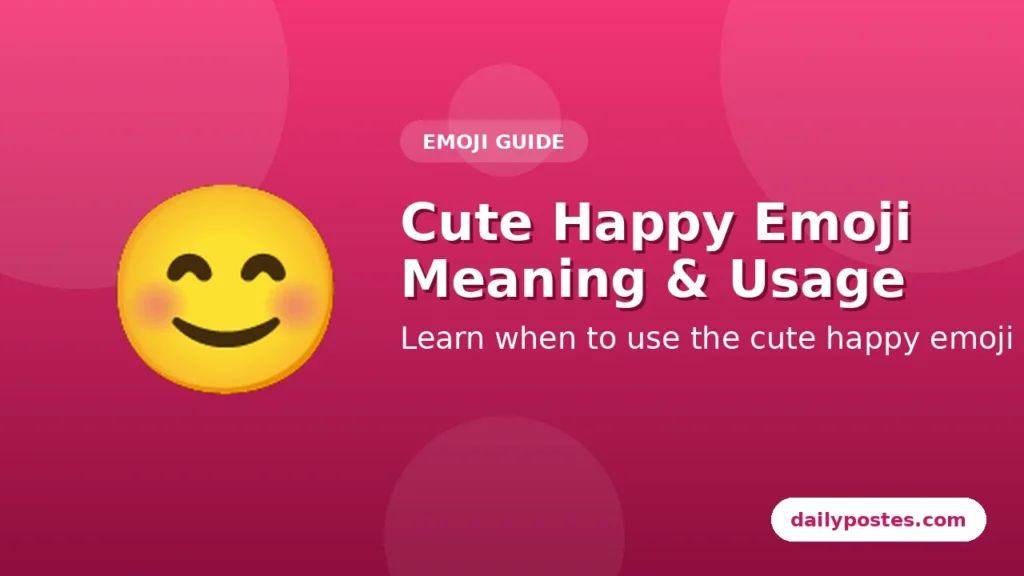
The 😊 cute happy emoji is the smiling face with smiling eyes. It means genuine warmth: a soft, shy, contented kind of happiness. Think blushing smiles, quiet joy, gratitude, and sweet affection. It is the “aww” of emojis. Copy it from the box above.
Quick Facts
| Emoji | 😊 |
| Unicode name | Smiling face with smiling eyes |
| Codepoint | U+1F60A |
| Shortcode | :blush: |
| Introduced | Unicode 6.0 (2010) |
In This Article
- What Does the 😊 Emoji Mean?
- Why Is the Cute Happy Emoji So Popular?
- What Does 😊 Mean in Texting?
- When Should You Use the 😊 Emoji?
- What Does 😊 Mean From a Girl?
- What Does 😊 Mean From a Guy?
- What Does 😊 Mean on TikTok and Instagram?
- 😊 vs 🙂 vs 😄: What’s the Difference?
- Does 😊 Look Different on iPhone and Android?
- Fun 😊 Emoji Combinations
- FAQs
What Does the 😊 Emoji Mean?
The 😊 emoji is officially called “smiling face with smiling eyes.” It shows a yellow face with a warm, closed-lip smile and two little curved smiling eyes. No open mouth, no teeth, no tears. Just soft, quiet happiness.
That combination matters. An open-mouth grin like 😄 says “loud joy.” The 😊 says something gentler: contentment, shyness, gratitude, or sweet affection. It is the emoji you use when something made you feel warm inside but you are not about to throw a party.
On many platforms (including iPhone), 😊 also carries a faint pink blush on the cheeks. That blush is the whole vibe of this emoji: a little bashful, a little tender, a little bit melted. People call it the “cute happy” emoji precisely because it radiates sweetness without trying too hard.
At its core, 😊 means genuine, unforced happiness. It is never sarcastic on its own, never cold, never passive-aggressive. It is the most trustworthy smile in the emoji keyboard.
Why Is the Cute Happy Emoji So Popular?
A few reasons explain why the cute happy emoji 😊 became one of the most-used emojis in the world.
First, it is the universal “aww.” Cute pets, babies, kind gestures, romantic texts — 😊 is the one-tap reaction for anything that melts your heart. It compresses an entire feeling into a single face.
Second, it is safe. Unlike 😏 or 😉, 😊 carries zero innuendo on its own. Unlike 😂, it is never inappropriate. People reach for it when they want to be warm without risking the wrong read. That makes it a daily driver in almost every kind of conversation.
Third, it works across generations. Teenagers, parents, and grandparents all read 😊 the same way: “I am happy and I like you.” Very few emojis survive the journey from Gen Z group chats to grandma’s birthday texts without changing meaning. 😊 does.
Fourth, the blush. That faint pink on the cheeks does a lot of emotional work. It turns a plain smile into something shy and human. A blush implies the feeling snuck up on you, which is exactly how real happiness usually feels.
What Does 😊 Mean in Texting?
In texting, 😊 has several common jobs:
1. Genuine happiness. “I got the job 😊.” Simple. Things went well, and you are smiling about it.
2. Shy warmth. “Hehe thanks 😊.” When someone compliments you and you do not quite know what to say, 😊 does the blushing for you.
3. Soft affection. “Goodnight 😊.” A gentle goodnight, a sweet “I care about you,” a warm sign-off. It says “I like you” without the weight of a heart emoji.
4. Gratitude. “Thank you so much 😊.” Adds sincerity to thanks. It reads as “I really mean it” rather than a flat polite thanks.
5. Calm contentment. “Cozy rainy day 😊.” That peaceful, everything-is-fine feeling. 😊 captures comfort better than any other face.
6. Light flirting. “See you tomorrow 😊.” By itself it is mild, but paired with sweet words, it hints “I like you a little more than just as a friend.” Context decides how flirty it is.
The rule of thumb: 😊 means the happiness is soft and sincere. Loud excitement gets 😄 or 😆. Quiet warmth gets 😊.
When Should You Use the 😊 Emoji?
Use it when:
- You feel genuinely happy, grateful, or content.
- Someone says something sweet and you want to show it landed.
- You are sending good news and want it to feel warm, not boastful.
- You want to flirt gently without coming on too strong.
- You need a safe, friendly sign-off in any conversation.
Do NOT use it when:
- You are actually annoyed and hoping the emoji hides it — passive-aggressive 😊 is a real thing people notice.
- Someone is sharing sad or serious news. A smiling face, however soft, reads as tone-deaf.
- The joke needs a bigger reaction. A genuinely funny moment deserves 😂 or 🤣, not a polite 😊.
- You are apologizing for something big. A soft smile does not fix real mistakes; words do.
Simple rule: match the emoji to the real size and softness of the feeling. 😊 is for warmth, not performance.
What Does 😊 Mean From a Girl?
When a girl sends 😊, it is almost always positive. But the shade of positive depends on context.
She is genuinely pleased. If she just shared good news or you made her day, 😊 means she is smiling for real. Take it at face value: you did well.
She is being sweet. “Good morning 😊.” This is the kind of warmth girls use to make a conversation feel nice. It says “I am happy talking to you.”
She is flirting softly. Paired with compliments or late-night texts, 😊 can mean she likes you. It is the low-pressure version of a flirty emoji — inviting, not pushy.
She is being polite. Sometimes 😊 is just the friendly option, the digital equivalent of a warm nod. “Sounds good 😊” usually means exactly that: sounds good.
The key: 😊 from a girl is one of the least ambiguous signals in texting. It is warm. The only question is how warm, and the conversation will tell you.
What Does 😊 Mean From a Guy?
From a guy, 😊 is less common than 😂 or 👍, which makes it worth noticing when it shows up.
He is genuinely happy or grateful. Guys do not sprinkle 😊 casually. If he uses it, he probably means it: “Thanks man 😊” is a real thanks.
He is softening the message. “No worries 😊.” Guys use 😊 to take the edge off a message that might otherwise read as blunt. It is the emoji equivalent of smiling while you talk.
He is being sweet on purpose. A guy sending 😊 in a conversation with someone he likes is choosing warmth deliberately. It is a small signal, but it is a chosen one.
He is responding to sweetness. If you sent something cute or kind and he replies 😊, that is his way of saying “that made me smile.” Mission accomplished.
What Does 😊 Mean on TikTok and Instagram?
On social media, 😊 is the wholesome reaction emoji. It is everywhere, and it means what it says.
On TikTok, 😊 fills the comments of feel-good content: puppy videos, reunion clips, wholesome pranks, “faith in humanity restored” posts. When the vibe is pure, 😊 is the default comment. It also softens captions, turning “new video out” into “new video out, hope you enjoy 😊.”
On Instagram, 😊 shows up in DMs and comments alike: replying to stories, reacting to cute photos, thanking followers. Creators use it to stay friendly and approachable without sounding corporate.
The pattern: 😊 marks content and conversations that feel kind. Where 😂 marks what is funny and 😭 marks what is emotional, 😊 marks what is simply nice.
😊 vs 🙂 vs 😄: What’s the Difference?
These three smiles get confused constantly. Here is the breakdown:
| Emoji | Name | Vibe |
| 😊 | Smiling face with smiling eyes | Warm and genuine — shy, sweet, truly happy |
| 🙂 | Slightly smiling face | Polite and neutral — a pleasant face with no strong feeling |
| 😄 | Grinning face with smiling eyes | Energetic and joyful — big, open, loud happiness |
Use 🙂 when you just want to seem friendly without emotional commitment. Use 😄 when you are visibly excited. Use 😊 when the feeling is real but soft: gratitude, shyness, comfort, or quiet joy.
Does 😊 Look Different on iPhone and Android?
Slightly, but the warmth survives everywhere.
On iPhone, 😊 has the classic look: yellow face, closed smiling eyes, a gentle closed-mouth smile, and the famous soft pink blush on the cheeks. The blush is what makes it “cute happy” — it gives the whole face a bashful, tender quality.
On Android and other platforms, the design is very close: same smiling eyes, same closed smile. Some platforms render the blush more faintly, and the exact shade of yellow varies. But the feeling lands the same.
One note: because the blush is most visible on iPhone, some Android users type 😊 expecting the blush and see a slightly plainer smile on their own screen. The recipient still gets the warm read either way.
Fun 😊 Emoji Combinations
Pair 😊 with other emojis to fine-tune the feeling:
| Combo | What it suggests |
| 😊💕 | Sweet affection — warm and a little romantic |
| 😊🙏 | Grateful and humble — “thank you, really” |
| 🥰😊 | Full cuteness mode — overwhelmed by sweetness |
| 😊✨ | Wholesome glow — everything is lovely right now |
| 😊🌙 | Sweet dreams — the perfect goodnight combo |
| 🐶😊 | Puppy-induced happiness |
| 😊💐 | Warm thanks or a sweet greeting |
| 😊☕ | Cozy contentment — morning coffee peace |
More Cute Emojis to Copy and Paste
Tap any emoji to copy it instantly, then paste it anywhere you like.
Tap any emoji to copy it. Paste it anywhere: WhatsApp, Instagram, TikTok, or your messages.
People Also Ask
What is the 😊 emoji officially called?
Its official Unicode name is “smiling face with smiling eyes” (codepoint U+1F60A). It was added in Unicode 6.0 back in 2010.
Does 😊 mean flirting?
It can, but it does not have to. 😊 is mainly warm and friendly. It only becomes flirty when the words around it are flirty too.
What is the difference between 😊 and 🙂?
😊 is warm, genuine, and a little shy (the blush gives it away). 🙂 is polite and neutral — friendly on the surface with no strong feeling underneath.
Why do people say 😊 is the “blush” emoji?
Because its shortcode is :blush: and many platforms (including iPhone) draw pink blush marks on its cheeks. It reads as bashful happiness.
Is 😊 appropriate at work?
Yes, mostly. It is one of the safest emojis for professional chats: friendly without being unprofessional. Keep it in appropriate doses.
What does 😊💕 mean together?
Sweet affection. The combo adds a romantic or deeply warm layer to the soft smile — “I really care about you.”
How do I type the cute happy emoji?
Open your emoji keyboard and search “smile” or “blush.” In Slack or Discord, type the shortcode :blush:.
Final Words About the Cute Happy Emoji
The 😊 cute happy emoji is the quietest smile in the keyboard, and maybe the most honest. It does not shout, flirt, or perform. It just says: I am happy, I am grateful, and I am glad you are here.
Use it when the feeling is soft and real. Let the little blush do the talking. And when someone’s kindness leaves you smiling at your screen, show them you mean it with a warm 😊 — because genuine affection never needs to be loud.
Want more? Explore Smileys & Emotion and Faces & Expressions for more emoji guides, or learn about DailyPostes.