
Tap the button to copy 😂
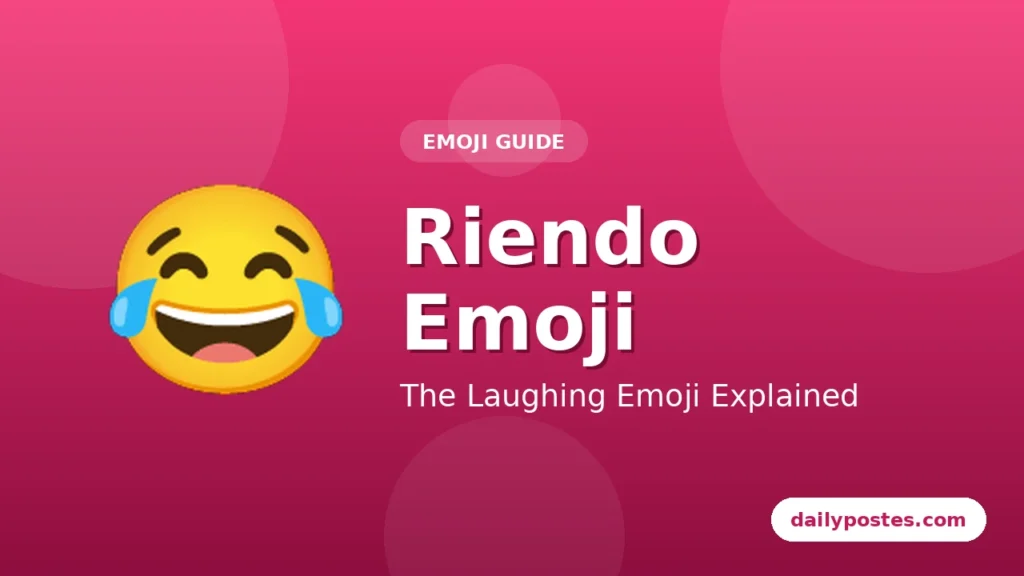
The 😂 emoji is the “face with tears of joy” — laughing so hard you cry. “Riendo” is Spanish for “laughing,” which is why Spanish speakers search for it this way. It means something is hilarious. Copy it from the box above.
Quick Facts
| Emoji | 😂 |
| Unicode name | Face with tears of joy |
| Codepoint | U+1F602 |
| Shortcode | :joy: |
| Introduced | Unicode 6.0 (2010) |
In This Article
- What Does the 😂 Emoji Mean?
- Why Do People Search “Emoji Riendo”?
- What Does 😂 Mean in Texting?
- When Should You Use the 😂 Emoji?
- What Does 😂 Mean From a Girl?
- What Does 😂 Mean From a Guy?
- How 😂 Became Word of the Year
- 😂 vs 🤣: What’s the Difference?
- Does 😂 Look Different on iPhone and Android?
- Fun 😂 Emoji Combinations
- FAQs
What Does the 😂 Emoji Mean?
The 😂 emoji is officially called “face with tears of joy.” It shows a yellow face laughing with eyes squeezed shut and tears streaming from both eyes. It means one thing: something is hilarious.
This is the laughter emoji. Not a smile, not a chuckle — full, helpless, tears-running-down-your-face laughter. When words like “haha” feel too small, 😂 does the job.
For years, 😂 was the most-used emoji in the world. It has been crowned the top emoji multiple times, and even Oxford Dictionaries named it the Word of the Year in 2015 — the first time a pictograph ever won. That tells you how deeply this laughing face is woven into digital life.
At its core, 😂 is simple: it turns text laughter into something you can see and feel.
Why Do People Search “Emoji Riendo”?
“Riendo” is the Spanish word for “laughing.” Spanish speakers often search “emoji riendo” (or “emoyi riendo”) when they want the laughing emoji — usually 😂.
It is the same emoji with a different name. English speakers call it the “laughing emoji” or “crying laughing emoji.” Spanish speakers call it “emoji riendo.” The meaning does not change across languages — laughter is universal.
So if you searched “emoji riendo,” you found the right face. 😂 is the one you want — go ahead and copy it from the box at the top.
What Does 😂 Mean in Texting?
In texting, 😂 is the default reaction to anything funny:
1. Something is hilarious. “Did you see his haircut 😂.” The classic use. It means “I am laughing right now.”
2. Softening a tease. “You are so slow 😂.” The emoji turns a roast into a joke. Without it, the same words could sting.
3. Reacting to memes and fails. Most 😂 usage in the wild is meme-adjacent. Funny video? 😂. Dumb joke? 😂. Absurd screenshot? 😂😂😂.
4. Awkward laughter. “Well, that was embarrassing 😂.” Sometimes it means “I don’t know what else to say, so I will laugh.”
5. Friendly tone marker. “See you tomorrow 😂.” Here it adds warmth, not comedy. It says “we are good, this is light.”
6. Crying from laughter (literal). When something is SO funny it hurts — 😂 means actual tears of joy.
Because it is so common, 😂 has become a punctuation mark of the internet — a signal that the vibe is fun.
When Should You Use the 😂 Emoji?
Use it when:
- Something genuinely made you laugh.
- You want to keep a tease light and friendly.
- Reacting to memes, jokes, and funny stories.
- You want to add warmth to a casual message.
- Someone said something awkward and laughter smooths it over.
Do NOT use it when:
- Someone is sharing sad or serious news. Laughing emojis there look cruel — even by accident.
- The joke is at someone’s expense and they are not laughing too.
- In professional messages. 😂 is casual by nature.
- You have already used it five times in one chat. Variety keeps it funny — try 🤣 or 💀 sometimes.
Simple rule: 😂 belongs wherever real laughter belongs.
What Does 😂 Mean From a Girl?
When a girl sends 😂, it is almost always positive.
She thinks you are funny. This is the big one. “Haha 😂” in response to your joke means you won. Keep going.
She is keeping it light. 😂 adds a friendly, flirty-adjacent warmth to casual chat. It signals comfort.
She is laughing at herself. “I just tripped in front of everyone 😂.” Self-deprecating humor — she is inviting you to laugh with her, not at her.
She is softening something. A small criticism wrapped in 😂 (“you never text back 😂”) is still a criticism — just a gentle one. Read between the lines.
What Does 😂 Mean From a Guy?
From a guy, 😂 is straightforward.
He is laughing. Nine times out of ten, that is the whole story. “That’s jokes 😂.”
He is vibing with you. Regular 😂 in a conversation means he is enjoying the chat and wants it to continue.
He is reacting to the group chat. Guys carpet-bomb group chats with 😂. Memes, banter, roasts — 😂 is the applause.
He found it funny but won’t admit how funny. One 😂 can mean a smirk; five 😂😂😂😂😂 means he actually laughed out loud.
How 😂 Became Word of the Year
In 2015, Oxford Dictionaries did something never done before: they named an emoji — 😂 — the Word of the Year. Not a word. A face.
Their reasoning was simple. That year, 😂 was the most-used emoji in the world, and its use had exploded. It was not just popular; it had become a core part of how people expressed themselves. Choosing it was Oxford’s way of admitting that digital language had changed.
The announcement made headlines everywhere — partly as a joke, partly as a milestone. But it proved something real: emojis were no longer decorations on text. They were the text. And 😂, the laughing face with tears of joy, was their king.
A decade later, it still reigns. Trends come and go, new emojis arrive yearly, but 😂 remains the default laugh of the internet.
😂 vs 🤣: What’s the Difference?
These two get confused constantly. Here is the difference:
| Emoji | Name | When to use it |
| 😂 | Face with tears of joy | Classic laughter — funny, warm, everyday hilarious |
| 🤣 | Rolling on the floor laughing | Extreme laughter — tilted head, bigger reaction, “I can’t breathe” |
Think of it as levels: 🙂 chuckle, 😂 laugh, 🤣 lose it completely. 😂 is the all-rounder; 🤣 is the upgrade when something breaks you.
Fun fact: younger texters have started using 💀 (skull) instead of 😂 for “I’m dead” laughter — but 😂 remains the universal default.
Does 😂 Look Different on iPhone and Android?
Barely. This is one of the most consistent emojis across platforms.
On iPhone, it is a yellow face with smiling closed eyes (like happy arcs) and two streams of tears. The grin is wide and the tears are prominent.
On Android and other platforms, it looks nearly identical: same closed happy eyes, same open smile, same tear streams. Minor art-style differences exist, but the face is instantly recognizable everywhere.
Consistency is part of why 😂 became the world’s top emoji — it looks the same no matter what phone you use.
Fun 😂 Emoji Combinations
Pair 😂 with other emojis to say it better:
| Combo | What it suggests |
| 😂😭 | Crying laughing — maximum hilarity |
| 💀😂 | “I’m dead” — laughed too hard to survive |
| 😂👏 | Applauding the joke — well played |
| 🤣😂 | Laughter overload, both tiers at once |
| 😂🔥 | “This is fire” — hilariously good |
| 🙈😂 | “I can’t even look” — secondhand embarrassment, but funny |
| 😂💯 | 100% hilarious — no notes |
| 🐒😂 | Monkeying around — pure silliness |
More Laughing Emojis to Copy and Paste
Tap any emoji to copy it instantly, then paste it anywhere you like.
Tap any emoji to copy it. Paste it anywhere: WhatsApp, Instagram, TikTok, or your messages.
Frequently Asked Questions
What is the 😂 emoji officially called?
Its official Unicode name is “face with tears of joy” (codepoint U+1F602). It was added in Unicode 6.0 back in 2010.
What does “emoji riendo” mean?
“Riendo” means “laughing” in Spanish. “Emoji riendo” is how Spanish speakers search for the 😂 laughing emoji.
Is 😂 still popular?
Yes — it remains one of the most-used emojis worldwide, even as younger users mix in 💀 and 🤣. It was Oxford Dictionaries’ Word of the Year in 2015.
What is the difference between 😂 and 😭?
😂 is laughing so hard you cry (happy). 😭 is sobbing (sad, or overwhelmed). Tears look similar — the mouth tells them apart: 😂 grins, 😭 wails.
Can I use 😂 in a work chat?
Sparingly. One 😂 in a casual team chat is usually fine; a stream of them looks unprofessional.
Why do some people say 😂 is “cringe”?
Some younger users joke that 😂 is for older generations and prefer 💀 for laughter. It is mostly playful gatekeeping — 😂 still works everywhere.
How do I type the laughing emoji?
Open your emoji keyboard and search “laugh” or “joy.” In Slack or Discord, type the shortcode :joy:.
Does 😂 mean the same thing everywhere?
Yes. Laughter is one of the most universal human expressions, and 😂 reads the same in every country. That is a big reason it became the world’s most-used emoji.
Final Thoughts
The 😂 emoji earned its crown. It is the sound of the internet laughing — billions of tiny tears of joy, shed daily in chats around the world.
Whether you call it the laughing emoji or emoji riendo, its job never changes: turning funny moments into shared laughter. Use it generously — the world can always use one more laugh.
Want more? Explore Smileys & Emotion and Faces & Expressions for more emoji guides, or learn about DailyPostes.